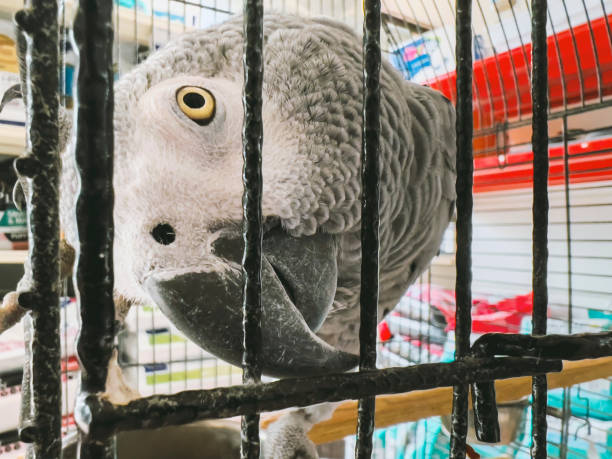
Intelligence and speech, without the marketing
The reputation is deserved and it is evidence-based. Three decades of work by Irene Pepperberg with a Grey named Alex demonstrated label learning, categorisation by colour, shape and material, and a functional grasp of the concept of zero. Companion Greys commonly acquire vocabularies in the hundreds of words and use many of them contextually rather than as random mimicry.
That same intelligence is the reason Greys are the species most often surrendered. A bird capable of contextual language is also capable of boredom, and an under-stimulated Grey becomes a feather-plucking, phobic or screaming bird within months. Foraging enrichment is not optional for this species; in the wild a Grey spends most of its waking hours searching for food, and a bowl of pellets removes that entire behavioural repertoire in one step.
Housing and noise
Minimum indoor enclosure is 91 x 61 x 122 cm (36 x 24 x 48 in) with 1.9-2.5 cm bar spacing. Greys are climbers rather than long-distance fliers indoors, so horizontal bars and varied perch heights matter more than raw floor area, but daily out-of-cage time in a bird-safe room is essential.
On noise, Greys are one of the more neighbour-friendly large parrots. They whistle, mimic microwaves, smoke alarms and telephones, and produce a repertoire of clicks and squeaks rather than the sustained screaming of a cockatoo or macaw. They are not silent, but they are a realistic proposition in more homes than most large psittacines.
Diet and the calcium problem
African Greys are unusually prone to hypocalcaemia - low blood calcium - which can present as seizures, tremors or sudden collapse in an otherwise healthy-looking adult. The mechanism is not fully settled, but the practical response is well established: feed a formulated diet rather than seed, include calcium-rich fresh foods such as kale, broccoli and other dark leafy greens, and ensure adequate vitamin D3, which is required for calcium absorption and which indoor birds under ordinary artificial light do not produce.
A working ration is roughly 60-70 per cent good-quality formulated pellet, 20-30 per cent fresh vegetables with a smaller share of fruit, and a small measured allowance of nuts and seed used for training rewards. Avoid blanket supplementation on top of a fortified pellet; oversupplying vitamin D3 is itself harmful.
Legal status and why it changed
Psittacus erithacus was transferred from CITES Appendix II to Appendix I at CoP17, effective January 2017, after population collapse driven by trapping for the pet trade. The IUCN Red List classifies the species as Endangered. In practical terms this means an African Grey in the EU falls under Annex A of Regulation (EC) No 338/97: commercial sale requires a bird-specific Article 10 certificate, the bird must carry a closed ring or microchip matching its paperwork, and any movement across an international border requires CITES export and import permits obtained before travel.
This is a good thing for buyers as well as for wild populations. Documentation that ties an individual bird to a legal captive-bred origin is the clearest protection against buying a laundered wild-caught bird.
Common health issues
- Hypocalcaemia and associated seizures - the signature Grey problem; ask your avian vet about baseline ionised calcium testing.
- Feather-destructive behaviour - overwhelmingly behavioural in origin, though allergy, giardia and zinc toxicosis should be excluded.
- Aspergillosis - fungal respiratory disease linked to damp substrate, poor ventilation and stress.
- Psittacine beak and feather disease (PBFD) - viral, incurable, and a reason to test and quarantine new arrivals.
- Respiratory sensitivity in the household - Greys produce powder down, which is a genuine consideration for people with asthma.
African Greys in our current listings
Related care guides
Choosing your first parrot · Parrot nutrition and diet conversion · Cage and aviary setup · Parrot lifespan by species · Recognising illness in parrots · Cages sized by species
African Grey parrots: frequently asked questions
Typically 40-60 years in captivity with good husbandry. This is a bird that will very likely outlive its first owner, so succession planning is part of responsible ownership.
Honestly, no. They are highly intelligent, emotionally sensitive, prone to becoming one-person birds, and quick to develop feather-destructive behaviour when under-stimulated. A cockatiel or a well-socialised conure is a far better first large-ish parrot.
Companion birds commonly reach several hundred words and phrases, often used in appropriate context. Individual variation is large and some Greys never talk at all, so never buy one on the assumption that it will.
In the EU, yes. The species is CITES Appendix I and EU Annex A, so a legal sale must come with a bird-specific Article 10 certificate and a matching closed ring or microchip. Cross-border movement additionally requires CITES export and import permits.
They are moderate by large-parrot standards. Expect whistles, mimicked household sounds and contact calls rather than sustained screaming, which makes them viable in more homes than macaws or cockatoos.
Most commonly boredom, lack of foraging opportunity, sleep deprivation, or the loss of a bonded companion. Medical causes including giardia, zinc toxicosis and skin disease must be ruled out by an avian vet first, but husbandry is the usual culprit and the usual fix.