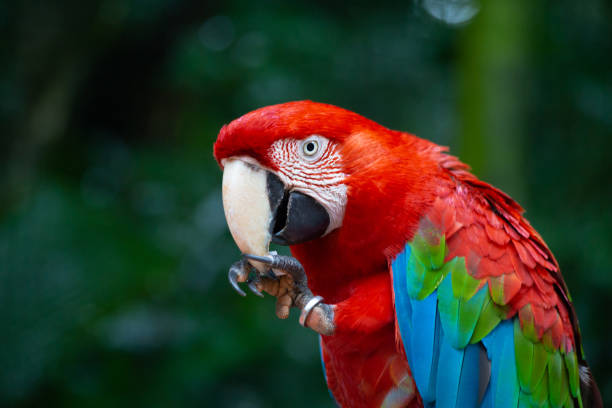
 Available Now
Scarlet Macaw
The Scarlet Macaw is a breathtaking large parrot with vivid red, yellow, and blue plumage....
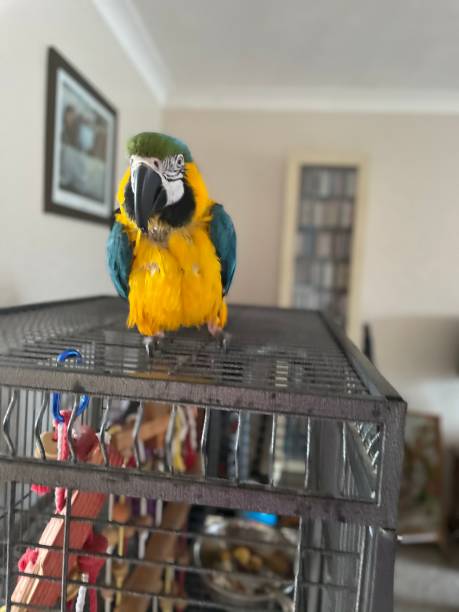 Available Now
Blue-and-Gold Macaw
Combines stunning beauty with a gentle, sociable temperament....
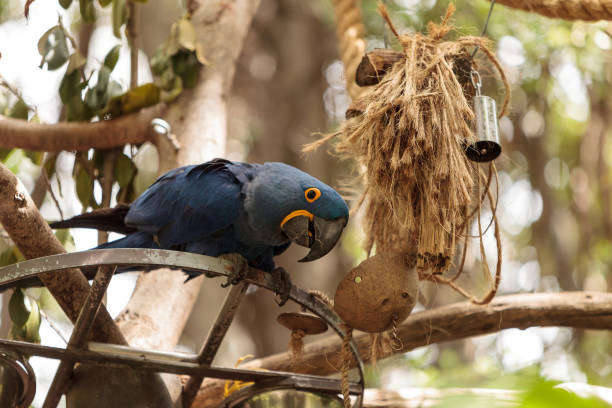 Available Now
Hyacinth Macaw
The largest of all parrot species with stunning cobalt blue plumage....
Which macaw suits which household
The three macaws grouped here differ far more than their shared silhouette suggests. Ara ararauna, the Blue-and-Gold, is generally the most tolerant of household routine and the most forgiving of a first-time large-parrot owner; it also learns a workable vocabulary of around twenty clear words. Ara macao, the Scarlet Macaw, is bolder, more reactive and more prone to sudden hormonal shifts in its sexually mature years, which begin at roughly four to five years old. Anodorhynchus hyacinthinus, the Hyacinth, is famously gentle for its size but needs so much space and such specific food that it belongs with experienced keepers who already have aviary infrastructure.
Noise is the factor that ends most macaw placements. All three species contact-call at dawn and dusk, and a macaw call carries for well over a kilometre in open habitat. In a terraced house or an apartment that is not a manageable sound. Macaws are not suitable for shared-wall housing, and no amount of training removes a natural contact call.
Minimum enclosure dimensions
Cage sizing for macaws is governed by wingspan and tail length, not body weight. A bird must be able to turn fully and flap without its primaries or tail striking the bars.
- Blue-and-Gold and Scarlet Macaw: minimum 122 x 91 x 152 cm (48 x 36 x 60 in) indoors, with 2.5-3.8 cm bar spacing and horizontal bars on at least two sides for climbing.
- Hyacinth Macaw: minimum 152 x 91 x 183 cm (60 x 36 x 72 in); a walk-in flight of 4.5 m or more is strongly preferred.
- Construction must be stainless steel or heavy powder-coated wrought iron. Macaws routinely destroy welded-mesh and thin-bar cages, and galvanised mesh carries a zinc-poisoning risk.
- Locks need to be bolt- or padlock-type. A macaw beak defeats spring clips and simple slide latches within days.
Diet: where macaws differ from every other parrot
Most companion parrots do badly on a high-fat diet. Hyacinth Macaws are the exception. In the Pantanal they feed almost exclusively on the nuts of two palms, acuri (Attalea phalerata) and bocaiuva (Acrocomia aculeata), and captive birds need a genuinely high-fat ration built on macadamia, brazil nut and palm nut alongside a formulated base. Scarlet and Blue-and-Gold Macaws sit in between: a good-quality formulated pellet should form roughly half to two thirds of intake, with fresh vegetables, some fruit, and nuts offered as a measured daily allowance rather than free-choice.
A macaw bite is the strongest of any parrot; a Hyacinth cracks macadamia shells that resist a household nutcracker. Feeding whole, in-shell nuts is enrichment as much as nutrition, and it keeps the beak in condition.
Legal status: read this before you enquire
Every parrot species is covered by CITES, the Convention on International Trade in Endangered Species. Macaws sit in two different tiers and the difference matters. Ara macao (Scarlet Macaw) and Anodorhynchus hyacinthinus (Hyacinth Macaw) are on CITES Appendix I, the most strictly controlled category. Ara ararauna (Blue-and-Gold Macaw) is on Appendix II.
Inside the European Union, CITES is implemented through Council Regulation (EC) No 338/97. Appendix I species appear in Annex A, and commercial use of an Annex A bird requires a species-specific Article 10 certificate issued by the member state, tied to that individual bird by a closed leg ring or microchip. Moving any of these species across an international border requires export and import permits arranged in advance. The EU has also prohibited imports of wild-caught birds since 2007 under Regulation (EC) No 318/2007, so birds legitimately available in Europe are captive-bred.
Health problems to watch for
Feather-destructive behaviour is the commonest presenting complaint in captive macaws and is almost always a husbandry or social problem before it is a medical one. Proventricular dilatation disease, caused by avian bornavirus, is a serious concern in large psittacines and is a reason to quarantine any new bird for 30-45 days away from an existing collection. Aspergillosis, a fungal respiratory infection, is associated with damp bedding and poor ventilation. Hypovitaminosis A follows an all-seed diet and shows up as recurrent sinus infections and poor feather quality.
Macaws in our current listings
Scarlet Macaw · Blue-and-Gold Macaw · Hyacinth Macaw
Related care guides
Choosing your first parrot · Parrot nutrition and diet conversion · Cage and aviary setup · Parrot lifespan by species · Recognising illness in parrots · Cages sized by species
Macaw parrots: frequently asked questions
Blue-and-Gold and Scarlet Macaws commonly reach 40-50 years in captivity with well-documented individuals passing 60. Hyacinth Macaws routinely exceed 50 and records above 80 exist. Plan for the bird to outlive you and name a guardian in your will.
Usually yes for attached housing. Macaws contact-call at dawn and dusk at a volume that carries over a kilometre outdoors. They are realistic only in a detached property, a dedicated bird room, or an outdoor aviary with tolerant neighbours.
Blue-and-Gold Macaws are the strongest talkers of the group and typically learn around twenty clear words plus whistles and household sounds. Scarlets and Hyacinths mimic less reliably. If speech is your priority, an African Grey or an Amazon is a far better match.
Recurring costs are food, replacement destructible toys, and avian veterinary care including an annual examination and periodic bloodwork. Macaws destroy wooden enrichment continuously, so toy replacement is an ongoing rather than occasional expense. Ask us for a written breakdown for the specific bird you are considering.
It depends on the species and your country. Scarlet and Hyacinth Macaws are CITES Appendix I / EU Annex A, which means commercial transactions require an Article 10 certificate within the EU and any cross-border movement requires CITES export and import permits. Blue-and-Gold Macaws are Appendix II. Always confirm the rules with your national CITES management authority before committing.
Bonded pairs of the same species often can, given an enclosure sized for two and multiple feeding stations. Mixing macaw species, or housing unbonded adults together, frequently ends in serious injury; a macaw bite can amputate toes.