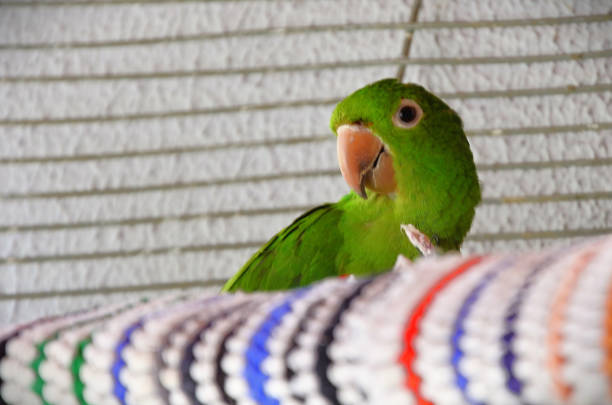
Behaviour: what "clown" actually means in practice
Caiques hop rather than walk, wrestle with toys on their backs, "surf" along towels and carpet by rubbing themselves along the surface, and play in a way that looks closer to a puppy than to a parrot. They are relentlessly, exhaustingly active. A caique that has not had two or more hours of vigorous out-of-cage play will not settle, and an unsettled caique becomes a screaming, nipping caique.
The nipping deserves its own warning. Caiques are among the bitiest parrots kept, not out of aggression but because beak contact is part of how they play. They bite hard enough to draw blood and they do not naturally moderate it. Households with young children should think carefully.
Housing and enrichment
- Minimum enclosure 61 x 61 x 91 cm (24 x 24 x 36 in), bar spacing 1.6-1.9 cm - but treat this as a floor, not a target. Wider is much better than taller for a bird that hops.
- Foraging is essential, not optional. Wrap food in paper, hide it in cardboard, use puzzle feeders, and make the bird work for a meaningful share of its daily intake.
- Provide a rotating supply of destructible toys - untreated softwood, palm leaf, vine, cardboard - and change them weekly. Caiques lose interest in static toys faster than almost any other species.
- Include a bathing dish or offer a daily fine mist. Caiques bathe enthusiastically and messily.
Range, status and legal position
Black-headed Caiques occur across the Amazon basin north of the Amazon river through the Guianas, Venezuela, Colombia, Brazil, Peru and Ecuador; White-bellied Caiques occur south of the river. The IUCN Red List classifies the Black-headed Caique as Least Concern, but the White-bellied Caique as Endangered, which is a meaningful difference if you care where your bird comes from.
Both species are CITES Appendix II, corresponding to EU Annex B. Commercial sale within the EU does not need an Article 10 certificate, but lawful origin must be demonstrable, and cross-border movement requires CITES export and import permits arranged in advance.
Diet and health
Caiques are frugivorous in the wild and take a broad range of fruit, seed, flowers and buds. In captivity aim for around 60 per cent formulated pellet with a generous daily serving of chopped vegetables and fruit, and use nut and seed sparingly as training rewards. They are enthusiastic eaters and tend to obesity if fed a rich diet without corresponding exercise.
Health points worth knowing: caiques are susceptible to psittacine beak and feather disease and to proventricular dilatation disease, making a 30-45 day quarantine and veterinary screening for new arrivals important. Their intense play behaviour makes traumatic injury - broken blood feathers, caught toes, falls - relatively common, so keep styptic powder in your first-aid kit and keep the bird's environment free of snag hazards.
Caiques in our current listings
Related care guides
Choosing your first parrot · Parrot nutrition and diet conversion · Cage and aviary setup · Parrot lifespan by species · Recognising illness in parrots · Cages sized by species
Caique parrots: frequently asked questions
Typically 25-30 years in captivity, with some individuals reaching 40. Do not let the small size mislead you about the commitment.
Poorly. Some learn a few words in a raspy voice, but their vocal repertoire is dominated by loud whistles and a sharp alarm call. Choose a caique for personality, never for speech.
Loud in bursts rather than continuously. Their whistles and alarm calls are piercing but not sustained the way a conure or cockatoo call is. They are more viable in a semi-detached house than most parrots of comparable personality.
Beak contact is part of normal caique play behaviour, not aggression. Consistent positive-reinforcement training, redirecting onto toys, and never withdrawing your hand sharply on a nip are the standard approaches. Expect it to take months rather than days.
Only for a beginner with a great deal of time. They need two or more hours of active out-of-cage play daily plus substantial foraging enrichment, and they are nippier than most first-parrot choices.
Sometimes, with careful introduction and an enclosure sized for two, but caiques can be seriously aggressive towards other birds including their own species. Never introduce them unsupervised, and be prepared to house separately.