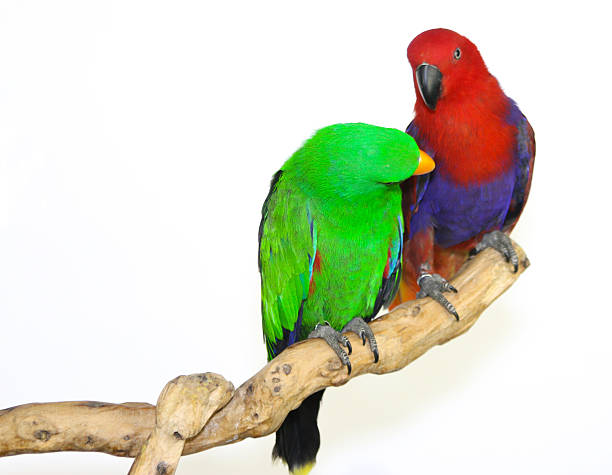
Range and taxonomy
Eclectus parrots occur naturally through the Solomon Islands, New Guinea, the Maluku (Moluccan) Islands and the Cape York Peninsula of north-eastern Australia. The group was long treated as a single species, Eclectus roratus, with numerous subspecies; recent taxonomic work splits it into several species including the Moluccan Eclectus (E. roratus), Papuan Eclectus (E. polychloros) and others. For a keeper the practical consequence is that adult size and shade vary noticeably by origin, so ask which population a bird descends from.
Eclectus have an unusual breeding system in the wild - females hold and defend nest hollows while multiple males provision them - which explains a good deal of captive behaviour, including the strong nest-cavity drive seen in hens.
Diet: the single most important thing to get right
Eclectus have a proportionally longer digestive tract than other parrots and evolved on a bulky, high-fibre, low-fat diet of fruit, flowers, buds, seeds and leaf matter. They absorb nutrients differently as a result, and they are the one commonly kept parrot where over-supplementation is a bigger risk than under-supplementation.
Excess synthetic vitamins, particularly from heavily fortified pellets combined with additional supplements, is widely associated in Eclectus with "toe-tapping" and "wing-flipping" - repetitive, involuntary-looking movements that usually resolve when the diet is simplified. The practical approach is a diet built on a large daily volume of fresh vegetables, fruit, sprouted pulses and leafy greens, with a low-fortification or non-fortified formulated pellet as a smaller component rather than the base, and no blanket multivitamin unless an avian vet has identified a deficiency.
- Offer fresh food twice daily; Eclectus eat a large volume relative to body weight.
- Emphasise fibrous vegetables, dark leafy greens, sprouts, papaya, mango, fig and pomegranate.
- Keep added fat low - Eclectus do not need the nut-heavy ration a macaw requires.
- Avoid stacking a fortified pellet, a vitamin supplement and vitamin-enriched treats on top of one another.
Housing, noise and temperament
Minimum indoor enclosure is 91 x 61 x 122 cm (36 x 24 x 48 in) with 1.9-2.5 cm bar spacing. Eclectus are calm, deliberate birds rather than acrobats, and they appreciate horizontal flight room more than climbing furniture; a longer cage beats a taller one.
They are moderate in volume - a distinctive bell-like honk and a clear speaking voice rather than a scream - and they produce very little powder down, which makes them one of the better large parrots for a household with dust sensitivity. Temperament is typically placid and slightly aloof; hens can become territorial and nest-driven at maturity, which is best managed by removing dark cavities, limiting day length to twelve hours and avoiding body petting.
Legal status and health
Eclectus are CITES Appendix II, which in the EU corresponds to Annex B of Regulation (EC) No 338/97. Commercial sale within the EU does not require an Article 10 certificate as it would for an Annex A bird, but the seller must be able to demonstrate lawful acquisition, and cross-border movement still requires CITES export and import permits. The EU has banned imports of wild-caught birds since 2007, so legitimately available birds are captive-bred.
Health concerns worth knowing: constricted toe syndrome in chicks reared at low humidity; feather-destructive behaviour, which in hens is frequently reproductive rather than psychological in origin; and diet-related toe-tapping as described above. Annual avian veterinary examination with a weight trend and a basic biochemistry panel catches most problems early.
Eclectuss in our current listings
Related care guides
Choosing your first parrot · Parrot nutrition and diet conversion · Cage and aviary setup · Parrot lifespan by species · Recognising illness in parrots · Cages sized by species
Eclectus parrots: frequently asked questions
The green male is camouflaged while foraging in the canopy; the scarlet-and-blue female is conspicuous at the nest hollow she defends against rivals. The dimorphism is so pronounced that the sexes were originally described as separate species.
Typically 30-50 years in captivity with appropriate diet and veterinary care.
It is strongly associated with excess synthetic vitamins and additives, usually from a heavily fortified pellet stacked with extra supplements. Simplifying to a fresh-food-led diet with a low-fortification pellet commonly resolves it. Have an avian vet exclude neurological and infectious causes as well.
Yes - they have an unusually clear, human-sounding voice and many learn substantial vocabularies. They are less compulsive mimics than African Greys but often more intelligible.
They are among the quieter large parrots, but they still produce loud contact honks and can be persistent. They are a better bet than a cockatoo or macaw, but no large parrot is genuinely apartment-safe.
They produce noticeably less powder down than cockatoos, African Greys or cockatiels, which many dust-sensitive keepers find significant. That is not the same as hypoallergenic - speak to your doctor first.