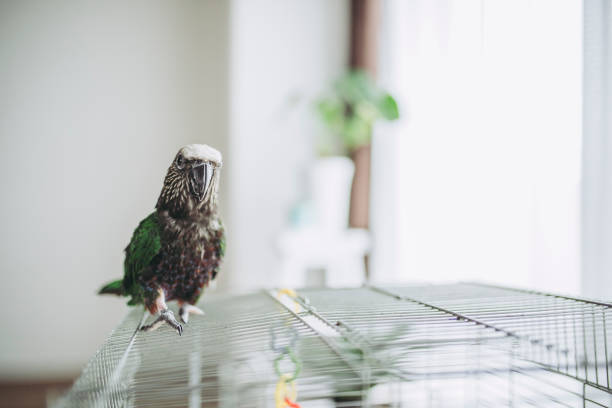
The ruff, and what it means
The elongated dark-red feathers of the nape and neck, edged in blue, lie flat in a relaxed bird and are raised into a broad disc when the bird is aroused, defensive or displaying. It is a communication signal, and it is also a useful welfare indicator: a bird whose ruff is up during routine handling is telling you something you should act on rather than push through.
Red-fans are excitable, intense and quick to escalate. They are capable of great affection with a trusted person and equally capable of a sudden hard bite when overstimulated. Reading the bird accurately - ruff, eye pinning, body posture - is a real skill and the main reason this species suits keepers with prior large-parrot experience.
Range and status
Deroptyus accipitrinus occurs in Amazonian lowland forest north of the Amazon river, across the Guianas, southern Venezuela, eastern Colombia, northern Brazil, eastern Peru and Ecuador. It is a canopy bird of undisturbed terra firme forest. The IUCN Red List classifies it as Least Concern, though it is uncommon in captivity and captive breeding is not straightforward.
The species is CITES Appendix II, corresponding to EU Annex B. Commercial sale within the EU does not require an Article 10 certificate but lawful origin must be demonstrable; cross-border movement requires CITES export and import permits obtained before travel.
Housing, diet and enrichment
- Minimum indoor enclosure 61 x 61 x 91 cm (24 x 24 x 36 in), but this species genuinely needs flight - an aviary or a large dedicated flight room is far more appropriate.
- Bar spacing 1.9-2.5 cm, stainless steel or heavy powder-coated iron; Red-fans chew persistently.
- Diet is fruit-led: a formulated pellet at roughly half of intake, with a large daily volume of fruit, vegetables, sprouted pulses and leafy greens. Keep fat moderate - a nut-heavy macaw-style ration is inappropriate.
- Enrichment must be intensive. Under-stimulated Red-fans develop feather-destructive behaviour and screaming quickly.
Health and lifespan
Expect 25-40 years in captivity. Health concerns are those of any Amazonian psittacine: psittacine beak and feather disease, proventricular dilatation disease, aspergillosis, and diet-related obesity or hypovitaminosis A. Because the species is uncommon, find an avian veterinarian with psittacine experience before you acquire a bird rather than after. Quarantine new arrivals for 30-45 days away from any existing collection.
Parrots in our current listings
Related care guides
Choosing your first parrot · Parrot nutrition and diet conversion · Cage and aviary setup · Parrot lifespan by species · Recognising illness in parrots · Cages sized by species
Parrot parrots: frequently asked questions
For the ruff of elongated red-and-blue neck feathers it raises into a broad fan when excited or defensive, which gives the head a raptor-like outline. The formal common name is Red-fan Parrot.
Typically 25-40 years in captivity.
Generally not. They are excitable, quick to escalate, capable of a hard bite, and demanding of space and enrichment. They suit keepers who already read parrot body language well.
Some learn a modest vocabulary but they are not notable talkers. Their natural repertoire includes loud, harsh calls.
A fruit-led diet: about half formulated pellet, with a large daily volume of fresh fruit, vegetables, sprouts and leafy greens. Keep fat moderate, unlike a macaw ration.
The species is CITES Appendix II / EU Annex B. No Article 10 certificate is required for a commercial sale within the EU, but the seller must be able to demonstrate lawful origin, and any international movement requires CITES export and import permits arranged in advance.