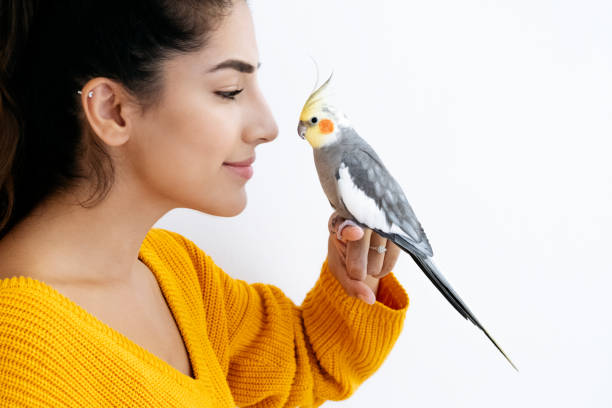
Origin and legal status
Cockatiels are native to the arid and semi-arid interior of Australia, where they move nomadically in flocks following water and seeding grasses. The IUCN Red List classifies them as Least Concern.
They also have an unusual legal position that is worth knowing precisely. Every species in the order Psittaciformes is listed on CITES Appendix I or II, with exactly four exceptions: the budgerigar (Melopsittacus undulatus), the cockatiel (Nymphicus hollandicus), the rose-ringed parakeet (Psittacula krameri) and the peach-faced lovebird (Agapornis roseicollis). Because the cockatiel is one of those four, it can be bought, sold and moved without CITES permits - one of the very few parrots for which that is true. National and local rules on keeping birds still apply.
Temperament, noise and talking
Cockatiels are gentle, hand-tame easily, and rarely bite with any force. Their voice is a whistle rather than a screech, and household volume is genuinely manageable - one of very few parrots that works in an apartment. Males whistle, learn tunes and mimic; hens are usually quieter and less inclined to mimic, though they are not silent. Speech, where it happens at all, is a soft warbling rather than the clear articulation of a Grey or Amazon.
They do produce a loud, sustained flock call when separated from their people, and they are prone to "night frights" - sudden panicked thrashing in darkness, often triggered by headlights or a noise. A dim night light and a cage without hazardous protrusions substantially reduce injury from this.
Housing and diet
- Minimum enclosure 61 x 46 x 61 cm (24 x 18 x 24 in), bar spacing 1.3-1.6 cm; wider is better than taller because cockatiels are horizontal fliers.
- Provide varied natural-wood perches of different diameters to prevent pressure sores, and avoid sandpaper perch covers entirely.
- Diet: cockatiels are the classic victims of the all-seed diet. Aim for 60-70 per cent formulated pellet plus daily dark leafy greens, grated carrot, broccoli and squash, with seed used as a measured treat rather than the base ration.
- Twelve hours of uninterrupted darkness nightly - this is the main lever for preventing chronic egg laying in hens.
Health problems that matter
- Obesity and hepatic lipidosis from seed-only diets - by far the commonest preventable cause of early death.
- Chronic egg laying and egg binding in hens - driven by long day length, rich diet, nest-like spaces and body petting. Hens can lay clutch after clutch and deplete their calcium reserves.
- Powder down - cockatiels are notable dust producers, relevant for anyone with asthma.
- Night frights causing broken blood feathers and head trauma - keep a styptic powder in your first-aid kit.
- Psittacosis (Chlamydia psittaci) - transmissible to humans; a reason to quarantine new birds and see an avian vet if a bird is fluffed, quiet and passing green droppings.
Cockatiels in our current listings
Related care guides
Choosing your first parrot · Parrot nutrition and diet conversion · Cage and aviary setup · Parrot lifespan by species · Recognising illness in parrots · Cages sized by species
Cockatiel parrots: frequently asked questions
Typically 15-25 years with good diet and veterinary care. Birds kept on seed-only diets frequently die well before ten, which is a husbandry outcome rather than a species limit.
They are among the few parrots that genuinely are. Their whistles and flock calls are audible but far below the volume of a conure, Amazon or cockatoo.
Males often whistle tunes and may pick up a few soft words. Hens rarely talk. If clear speech is the goal, a cockatiel is the wrong bird.
No. The cockatiel is one of only four parrot species exempt from CITES listing, alongside the budgerigar, the rose-ringed parakeet and the peach-faced lovebird. Ordinary national rules on animal keeping and transport still apply.
A single bird with several hours of daily human interaction does well and usually tames more readily. A pair is better if the household is out all day, but a bonded pair generally stays less interested in people.
Night frights are a well-known cockatiel behaviour - a sudden panic response in darkness, often set off by a headlight or a noise. A dim night light, a cage clear of snagging hazards, and styptic powder on hand for a broken blood feather are the standard responses.