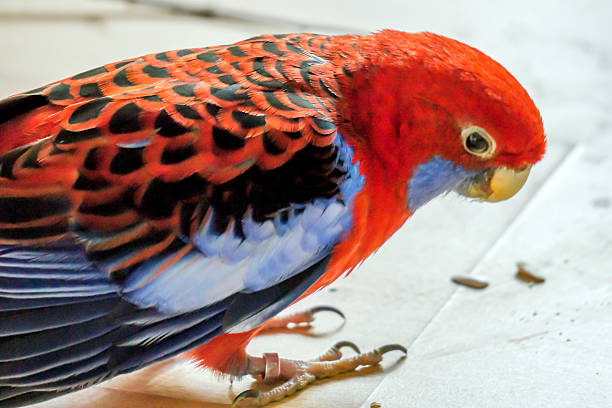
Why a rosella is not a hands-on pet
Rosellas are ground-foraging, strongly flighted birds that do not naturally seek physical contact with a flock-mate, let alone a human. Hand-reared individuals tolerate handling and can be trained with positive reinforcement, but they do not solicit head scratches, do not enjoy being held, and generally become less tolerant of handling with age. If you want a bird that sits on your shoulder, choose a cockatiel, a conure or an Eclectus.
What they offer instead is spectacular colour, constant activity, sustained flight, and a household presence that requires far less emotional labour than a cockatoo. In a well-planted aviary they are endlessly watchable.
Housing: length matters more than height
- A flight of at least 3 m in length is strongly recommended; more is better. A conventional parrot cage of 76 x 46 x 91 cm (30 x 18 x 36 in) is the absolute indoor minimum and should be regarded as overnight accommodation, not a home.
- Bar spacing 1.6-1.9 cm. Rosellas are not heavy chewers by macaw standards, but wire quality still matters.
- Provide ground foraging opportunity - rosellas feed on the ground in the wild, and a shallow tray of safe substrate with scattered seed satisfies a real behavioural need.
- House one pair per flight. Rosellas are notably intolerant of conspecifics outside the breeding pair and serious injury results from crowding.
Range, status and legal position
Crimson Rosellas occur through eastern and south-eastern Australia and have been introduced to Norfolk Island and New Zealand. The IUCN Red List classifies them as Least Concern. Australia has prohibited commercial export of native wildlife for decades, so birds in Europe descend from long-established captive populations.
Like almost every parrot, Platycercus elegans is CITES-listed - Appendix II, corresponding to EU Annex B. Commercial sale within the EU does not require an Article 10 certificate, but lawful origin must be demonstrable, and cross-border movement requires CITES export and import permits arranged in advance.
Diet and health
Rosellas eat a broader diet than most people expect: seeds, fruits, buds, flowers, nectar and a meaningful quantity of insect matter, particularly when rearing young. In captivity build on a quality formulated pellet or a good small-parakeet seed mix supplemented heavily with fresh greens, sprouted seed, and fruit, with occasional egg food especially during breeding.
The dominant health risk in aviary rosellas is intestinal parasitism, especially roundworm, because they feed on the ground and re-ingest from the floor. A regular faecal screening and worming schedule set by an avian vet is essential in a way it is not for a cage-kept parrot. Watch also for psittacosis and for reproductive problems in hens.
Rosellas in our current listings
Related care guides
Choosing your first parrot · Parrot nutrition and diet conversion · Cage and aviary setup · Parrot lifespan by species · Recognising illness in parrots · Cages sized by species
Rosella parrots: frequently asked questions
Typically 15-25 years in captivity, with well-managed individuals reaching around 30.
Very rarely and very poorly. They produce a pleasant bell-like whistle and a sharp alarm call. Do not acquire one hoping for speech.
They are best appreciated visually rather than handled, which can suit a family that wants to observe birds. They are not a bird for a child who wants to hold and cuddle a pet.
Only with great care. Rosellas are aggressive towards other rosellas and towards similarly sized parakeets, and mixed-species aviaries containing them frequently end in injury. One pair per flight is the safe rule.
Yes, and more than most parrots. Because they forage on the ground they re-ingest parasite eggs from the aviary floor, so routine faecal screening and a worming schedule agreed with an avian vet are part of normal care.
Moderate. A ringing, musical contact call and a piercing alarm call, but nothing like the sustained volume of a conure or cockatoo.