Range and conservation status
Sun Conures have a genuinely tiny natural range: the Roraima region of northern Brazil, southern Guyana, the extreme south of Suriname, and parts of French Guiana, in seasonally flooded savanna and forest edge. The IUCN Red List classifies the species as Endangered following steep declines driven by trapping for the pet trade. The species is on CITES Appendix II, corresponding to Annex B in the EU.
The contrast between how common Sun Conures are in captivity and how scarce they now are in the wild is worth pausing on. Captive breeding in Europe and North America is well established, and the EU has prohibited wild-bird imports since 2007 under Regulation (EC) No 318/2007, so birds legitimately available here are captive-bred.
Volume: the thing people underestimate
A Sun Conure's alarm call is a piercing, metallic screech that carries easily through internal walls and closed windows. They call for contact, on waking, at dusk, when you leave the room and when a car door slams outside. This is entirely normal behaviour that cannot be trained away, only channelled and reduced. Prospective owners regularly assume that a 120 g bird must be quiet; the opposite is true, and noise is the single most common reason Sun Conures are rehomed.
On the other side of that ledger, they are affectionate, endlessly playful, comfortable with handling, and far less prone than larger parrots to the destructive hormonal aggression that arrives at maturity in Amazons and cockatoos.
Housing and diet
- Minimum enclosure 61 x 61 x 91 cm (24 x 24 x 36 in); bar spacing 1.6-1.9 cm so a small head cannot become trapped.
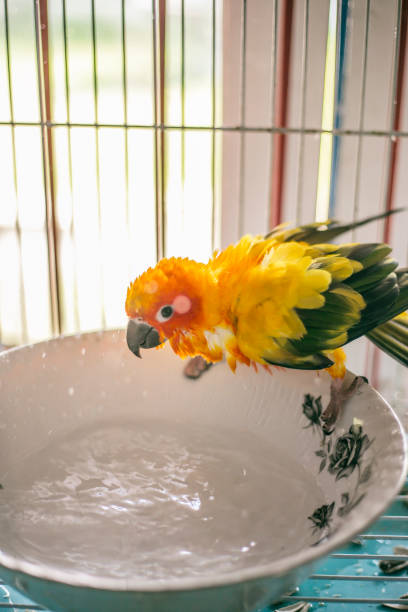
- Conures are active climbers and enthusiastic bathers - include a shallow dish or offer a daily fine-mist spray.
- They sleep in cavities in the wild and many appreciate a tent or a covered corner; watch closely for reproductive behaviour if you provide one, and remove it if the bird becomes territorial.
- Diet: roughly 60-70 per cent formulated pellet, daily fresh vegetables and modest fruit, with seed and nut used as measured training rewards.
Health
Conures are susceptible to psittacine beak and feather disease and to proventricular dilatation disease, so quarantine any new bird for 30-45 days and have new arrivals screened. Conure bleeding syndrome, a vitamin K-responsive haemorrhagic condition, is documented in the group. Obesity and fatty liver disease follow all-seed diets as they do in every parrot. Weigh weekly on a gram scale - in a bird this small, a 10 g loss is a significant clinical sign that is invisible to the eye.
Conures in our current listings
Related care guides
Choosing your first parrot · Parrot nutrition and diet conversion · Cage and aviary setup · Parrot lifespan by species · Recognising illness in parrots · Cages sized by species
Conure parrots: frequently asked questions
Very. The contact and alarm calls are sharp, metallic and carry through walls and closed windows. Relative to body size they are among the loudest parrots kept. Assume neighbours will hear the bird.
Typically 15-25 years in captivity, with well-cared-for individuals reaching 30. That is a serious commitment for a small bird.
A few learn a handful of words in a gravelly voice, but most do not talk meaningfully. Buy a Sun Conure for its personality and colour, not for speech.
They are handleable, affectionate and forgiving, which suits a beginner - but only one who has genuinely accounted for the noise and for a 20-plus year commitment.
They are highly social and do well in pairs, though a paired bird typically bonds less intensely with people. A single conure needs several hours of daily interaction and substantial foraging enrichment.
Yes. The IUCN Red List classifies Aratinga solstitialis as Endangered because of trapping pressure and habitat loss across its small range in northern Brazil and the Guianas. The species is listed on CITES Appendix II.